
Goblins is the only math platform shown to double math growth.
Our district partners consistently report being surprised by how quickly growth appeared, and 3 independent research supports their experience across thousands of students.
Deer Valley unified
U Maryland concluded that “there is a strong positive relationship between Goblins usage level and math achievement.”
+2 years
of learning in 1 schoolyear at just 30 minutes a week.
7×
the effect of DreamBox, Zearn, MATHia and ST Math at 30 minutes a week (+0.69 SD).
10×
as many students reach the growth threshold as in Khan Academy's landmark study.

Researcher

Tier

Independent funder
35
Schools
Key finding #1
Students using Goblins grow a lot with minimal lift.
It doesn't take much usage to see a notable effect. At just 2 problems a week (about 5 minutes a week), students achieved +0.237 standard deviations (SD) in NWEA MAP's conditional growth index (CGI) score, a nationally normed reference for how much a student grew above what they were expected to grow. This is roughly equivalent in the research literature to the difference between an average teacher and an excellent teacher. In other words, using Goblins is like taking your average teachers and turning them into your best. Another way to think about this is additional learning time, where 0.237 SD equates to about 3 added months of class time.
- Students who did not use Goblins
- Baseline
- Students solving at least two Goblins problems per week
- +3 months
Key finding #2
Students doing about 30 minutes per week grew almost 2 school years in 1.
The Maryland researchers also found that increasing the dosage of Goblins beyond 2 problems per week was associated with more growth. Students who solved 10–19 problems a week grew 0.40 SD, and those solving 20 or more problems per week (about 30 minutes) grew 0.69 SD, or about 6.9 added months of learning.
This is still a low lift for teachers. It asks for less time than standard math platforms typically do, which makes Goblins a more effective use of screen time than alternatives.
- About 5 minutes, or 2 problems, per week
- +3 months
- About 30 minutes, or 20 problems, per week
- +6.9 months
For context, this effect is much larger than the effect sizes typically found for supplemental and intervention math products. To compare products on the same basis, the chart below assumes about 30 minutes of weekly use. For Goblins, that is roughly 20 or more problems per week.
- DreamBox
- +0.10 SD
- Zearn
- +0.03 SD
- MATHia
- +0.04 SD
- ST Math
- +0.07 SD
- Goblins students using the product about 30 minutes per week
- +0.69 SD
Key finding #3
Goblins gets extra growth for the students who are hardest to reach.
Students who need math support the most have historically been the ones most poorly served by technology. Researchers call this “The 5% Problem”: most studies discard the 95% of students who did not meet the treatment threshold. Goblins may be the first to solve it. Roughly 51% of Goblins students reached the same level of growth featured by Khan Academy in its landmark study. That is about 10 times as many students.
- Khan Academy students who reached the treatment threshold
- 5%
- Goblins students who reached the treatment threshold
- 51%
Source: Khan Academy
Maryland also found something surprising: Hispanic students, students with an IEP, and English language learners appear to benefit much more from Goblins than their counterparts, showing about 0.8, 1.2, and 1.9 additional months of growth, respectively. This is unusual too. It highlights how Goblins' accessibility features, which let students speak and draw, and its ability to build confidence make it possible for students who might not engage in class to find new joy in math.
- Hispanic students
- +0.8 months
- Students with IEP
- +1.2 months
- English learners
- +1.9 months
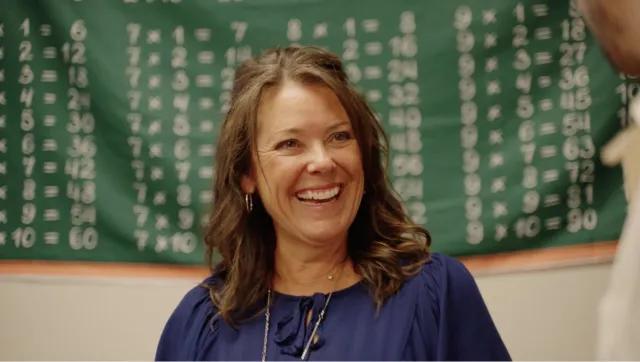
DREAM Charter High School · Bronx, NY
In 8 weeks, 4 times as many students passed the Algebra I Regents.
4×
as many students passed the Regents.
10×
the growth of a typical math tool in 8 weeks (+0.20 SD).
+8 pts
Regents swing for the lowest-scoring third.
Leanlab Education
Researcher
127 students, grades 8–9
Students
Intervention
Context
In spring 2026, Leanlab Education, an independent evaluator, studied Goblins at DREAM Charter High School. 127 students in grades 8 and 9 used Goblins for 8 weeks before the June Algebra I Regents exam. They gained 0.20 standard deviations, about 10 times what a typical math tool achieves in the same time. The lowest-scoring third gained 5 Regents points, while similar students who did not use Goblins lost 3.
- Typical math tool over 8 weeks
- 0.02 SD
- Goblins students at DREAM Charter High School over 8 weeks
- +0.20 SD

Cabarrus + Vance County · North Carolina
In North Carolina, a few weeks of Goblins added the difference between an average teacher and an excellent teacher.
+0.18 SD
over district peers on i-Ready (Vance County).
+0.15 SD
on the Math 1 end-of-course exam (Cabarrus County).
University of Maryland
Researcher
567 HS and MS students
Students
Virtual School + In-Person
Context
In spring 2026, researchers at the University of Maryland's Center for Educational Data Science and Innovation studied Goblins at a Cabarrus County high school. Regular users scored 0.15 standard deviations higher on the Math 1 end-of-course exam. In Vance County, middle schoolers who used Goblins for 5 to 6 weeks outgrew their district peers by 0.18 standard deviations on i-Ready, roughly a full year of typical growth.
- Students who did not use Goblins
- Baseline
- Cabarrus County, Math 1 end-of-course exam
- +0.15 SD
- Vance County, i-Ready
- +0.18 SD
All independently funded
Districts spend billions on tools that do not move the needle. Incredibly, this is what many vendors' own studies show. Many vendors also commission the studies themselves and hire private companies to perform and certify them.
The University of Maryland and LeanLab studies were instead independently funded by Accelerate and NewSchools, collaboratives interested in AI and high-dosage tutoring solutions.