How Goblins Helped DREAM’s Lowest Performing Algebra I Students Pass the Regents Exam
Tier 3 intervention · Bronx, NY
In only 8 weeks, Goblins boosted the 249 students who used Goblins an average of +4 points on the Regents exam.
And among the lowest-scoring third of the class, Goblins users grew even more: +5 points (while similar students who didn't use it lost 3, an 8-point swing), and 4x as many students passed the Regents.
- Lowest-scoring third of the class, by January score, who did not use Goblins
- Lost 3 points on the Regents exam
- All students who used Goblins
- Gained 4 points on the Regents exam
- Lowest-scoring third of the class, by January score, who used Goblins
- Gained 5 points on the Regents exam
DREAM Charter High School, spring 2026. Growth measured from January to the June Regents exam. "Lowest-scoring third" by January score.
An independent evaluator, Leanlab Education, found an effect size of 0.20 standard deviations of growth, roughly about the difference between a student having an average teacher and an excellent one — for an entire year, and in the top third of all studied education programs. Seeing that in just 8 weeks is extremely unusual.
- Typical math tool
- About 0.02 standard deviations in 8 weeks. The median education intervention moves achievement 0.10 standard deviations over a full school year (Kraft, 2020), pro-rated to 8 of 36 weeks.
- Goblins at DREAM
- 0.20 standard deviations in 8 weeks, about 10 times the typical math tool over the same period, in the top third of all studied education programs (Leanlab Education, 2026)
Typical math tool: Kraft, M. A. (2020). Interpreting Effect Sizes of Education Interventions. Educational Researcher. The median education intervention moves achievement 0.10 SD over a full school year, shown here pro-rated to 8 of 36 weeks and rounded to two decimals; the 10x compares the rounded figures. 0.20 SD is the threshold for a large effect and puts a program in the top third of those studied.
Goblins effect size: Leanlab Education (2026). Evaluating Goblins: A Quasi-Experimental Study of an AI-Powered Math Tutoring Tool. Hedges' g = 0.20.
Catching up low-performing students, who generally have foundational gaps from previous years, is tricky. Teachers are simultaneously trying to keep up with their Tier 1 scope and sequence while also filling in those gaps via differentiation. There's just never enough of them to go around. Whereas pull-out intervention blocks usually sit kids in front of software that doesn't solve the problem. As Kaitlyn LiPuma, math department chair at DREAM Charter School, illustrated, "with adaptive math tools, students end up on a demoralizing slide: you don't know that? Do you know this? And suddenly a ninth-grader is all the way down at a second-grade level, and they don't want to participate because the program is basically calling them stupid."
We were introduced to DREAM through our partnership with NewSchools, and they were trying to solve this exact problem, with a special focus on Algebra I. Fred Schaefer, Assistant Principal of Curriculum & Instruction, described the stakes:
"We're an algebra-for-all school in eighth grade. If students can't do well in Algebra 1, there's no way they're going to do well in college-level math. And we've been really struggling to get our kids to pass the New York States Regents exam."
They picked the 40% of 9th-grade students who were below grade level for an intervention block. They went looking for a tool to help in Spring 2026, but were soon disappointed. Adam Feiler-Ware, Deputy Chief of Learning, described how "our concern was always: can we even put a tool in front of students? We looked at enterprise ChatGPT for students, we looked at MagicSchool, but none of them was really getting math right."
Goblins is different. "What was exciting about Goblins was that, at first glance, it actually seemed to know math," Adam noted. "But what impressed me most was the ability to precisely figure out the misconception a student was having, something a lot of AI tools have not been able to do, and to scaffold up to a high level of rigor while building deep rapport through the avatar."
Next they showed it to the teachers, who naturally "received Goblins at first with a little skepticism," Adam recounted. "But once teachers started using it themselves and saw the impact on students, that's when we really saw them come on board."
They started noticing a deeper difference between Goblins and the other AI math tools they had seen.

“Most of the other AI math tutoring tools we've seen focus on procedural, step-by-step prompting, just leading kids to the answer, which doesn't then transfer their thinking to another problem. That really sets Goblins apart. Because of those multiple modalities, Goblins lets students show their thinking, as opposed to just typing responses into a chatbot, which a lot of the other tools do.”
Fred agreed, "It doesn't spoon-feed the answers, which a lot of edtech and AI do."
Kaitlyn emphasized how she noticed it quickly building students' confidence: "What's unique about Goblins is it fine-tunes to that exact gap, scaffolds down to it, then brings them back to the on-grade-level assignment, so when they talk about it with their friends, they build confidence because they're working on the same things. It pinpoints the issue without making students feel like they're less than."
Here's some of the things students were saying:
“I did not like algebra at all. So when I started using Goblins, I started understanding it more, and then I started liking it.”
“What I like about it is it doesn't give you the answer right away. It will ask you questions, it will guide you through the steps.”
“It made me feel more confident in my work. Before I would struggle with little things, but it taught me how to break it down and make it easier for me.”
“It just became fun. If you understand it, it's just fun.”
A “Paradigm Shift”
Teachers used Goblins for independent practice during class, in college-ready blocks and study halls, and as homework — typically 20 minutes, two to three times a week.
DREAM began using Goblins "as the primary tool, with teachers providing more targeted circulation and monitoring, and small-group pull, while students work independently with Goblins to scaffold up toward algebra-ready skills." Indeed, Fred described Goblins as a "paradigm shift, where a teacher can launch students into independent practice, be confident they're getting the support they need on a base level, and see in real time what students are struggling with so they can pinpoint and do personalized instruction for that student as well." He added, "It's not replacing a human, it's amplifying an existing teacher's ability to reach 17 kids in the classroom."
It also collapses the gap between assessment and instruction, and gives their team a much higher-fidelity window into students' authentic process, relieving another burden for them. Kaitlyn captured the previous paradigm, where "students are being assessed on a very frequent basis. The upside is you have all that data; the downside is you're losing a lot of class time, and a lot of that independent practice time students need to make a topic feel sticky." Whereas Goblins, "is really excellent at diagnosing where the gap is happening in real-time." It even helped Kaitlyn and her colleagues level up their own Tier 1 instruction, "by moving me from making generalized statements about where I think student misconceptions are, to very fine-tuned moments that can be really impactful to fixing that gap."
By saving DREAM’s teachers time, it made possible a more human form of education.
It is rare to find in a tool the combination of time-saving and achievement-boosting. Kaitlyn noted how "a huge thing we deal with is time as teachers. I don't have enough time in class, after school, at home, and I don't want to bring work home with me." Goblins frees her up. "The time we're able to save through Goblins, addressing the gaps we don't have time for in class, is why we're seeing a huge amount of student success."
Further, parents and educators are rightfully insisting more than ever on quality screentime for their students. DREAM is very intentional about this. Adam noted, "We have a deep belief at Dream that the human plays a central role in learning, because learning is only about 10 to 20% about the content." We fully agree. We believe in using these new technologies to strengthen educators' interpersonal connections with students, and so we designed Goblins to give educators more leverage over the precious time they have with their students. Adam noticed this: "Because the insights on the dashboard are so precise, teachers can see which students react to the scaffolds and which need more support, and target those kids with that additional human touch."
The Results
DREAM "created an internal experiment", said Fred. They had "one intervention class, where the lower-performing 40% of students used Goblins, and the others didn't. The students using Goblins had the most significant growth on our internal assessments."

“From semester 1 to semester 2, the students exclusively using Goblins made up most of the growth we saw in the entire cohort.”
It's important to emphasize just how much this defied the trend for edtech tools. Fred stated just this, "It was surprising to see, that level of increase for the lowest-performing students was something we were really excited about, it shows the promise of this tool."
Kaitlyn was excited, too. "I'm going to see a lot of students pass the Algebra 1 Regents that I wouldn't have expected to at the beginning of the year." And what's more, the ones who "use Goblins religiously, finishing all their homework, working it in their college-ready blocks and study halls, I've seen exponential growth. On formative assessments, completion rates, participation, I'm just seeing them go up and up and up, and be so much more confident when they're working in groups, feeling like they can actually contribute."
This result is consistent with findings in other districts.
DREAM isn't an outlier. In a spring 2026 pilot evaluated by the University of Maryland's Center for Educational Data Science and Innovation, Math 1 students at a Cabarrus County, NC high school who used Goblins regularly scored 0.15 standard deviations higher on the North Carolina EOC. In Vance County, NC, middle schoolers using Goblins outgrew district peers by 0.18 SD on iReady in five to six weeks — a statistically significant result, and roughly a full year of typical growth.
DREAM Recommends Goblins
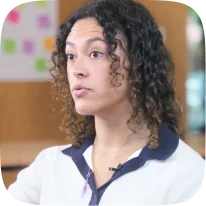
“I'd 100% recommend Goblins. I truly believe it's where education is evolving towards, and Goblins is ahead of it.”
She added, "I truly have such an amazing toolkit that's now part of my teacher practice. Goblins solves the problem of making content 100% accessible to 100% of kids." To which we say, 💯.
Fred believes, "it would be crazy for people to not engage with this tool."
Adam too: "I would definitely recommend Goblins if you're piloting an AI tool for math, the right balance of human and AI, that prioritizes conceptual understanding, gives strong insights on the back end, and allows for multiple modalities. Goblins is really a strong choice." He then added something else that is so rare, "We have students who do Goblins at home just because they enjoy it so much and they feel like they're making growth and progress."